CHAPTER 4: THE AUDIT OF POWER
CHAPTER 4: THE AUDIT OF POWER
The first thing JSOC did was remove emotion from the room.
Not forcefully.
Systematically.
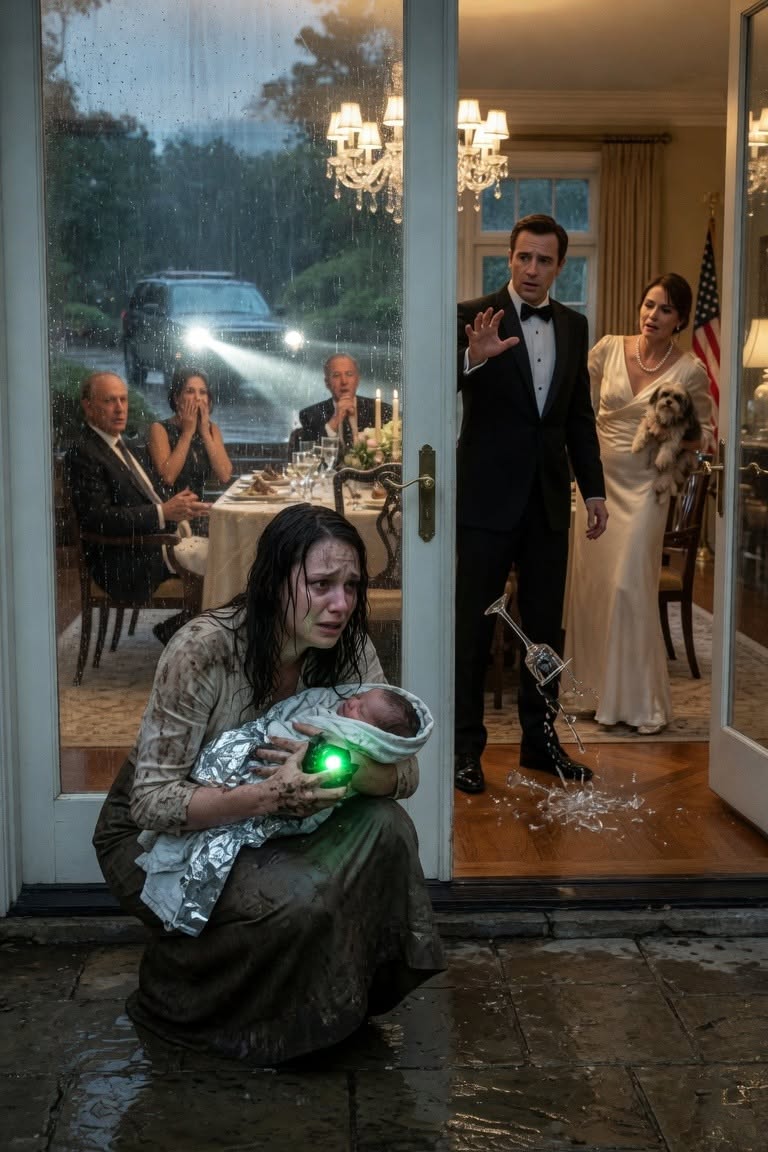
Phones were collected without debate. Wi-Fi was cut at the estate router like a vein being pinched shut. Every guest’s identity was quietly verified against a live federal registry feed running on a secured tablet I couldn’t even see from my position in the mud.
The mansion didn’t feel like a home anymore.
It felt like a site.
A location under review.
Inside, Richard Whitmore was no longer speaking like a man hosting a dinner party.
He was speaking like a man trying to reassemble reality in real time.
“You can’t just walk in here and take control of my property,” he said to the JSOC operator nearest the dining table. “I have attorneys. I have—”
“You have a pediatric emergency in your backyard,” the operator interrupted.
No raise in volume.
No hostility.
Just fact, placed on the table like an object no one could argue with.
The neonatal specialist remained outside with me, his focus entirely on Leo. The oxygen line hissed softly, a controlled rhythm replacing the chaos of minutes earlier.
“Stabilization is holding,” he said. “But he’s still vulnerable to rebound apnea. We need transport to NICU-capable facility immediately.”
“I know,” I said.
My voice felt distant.
Not because I was detached.
Because something else in me had already shifted into a different operating mode—one that didn’t waste energy on disbelief.
Eleanor finally stepped fully into the rain.
She stopped at the edge of the patio like the water might contaminate her if she went further.
“This is absurd,” she said again, weaker this time. “She’s just… she’s emotional. She always—”
“Ma’am,” the operator near her said quietly, “step back inside.”
It wasn’t a suggestion.
But it wasn’t cruelty either.
It was containment.
Richard looked between them, then at me.
For the first time, I saw it clearly in his face—not anger now.
Calculation.
He was trying to find leverage.
Something to pull the world back into the shape he understood.
“You activated a military beacon,” he said, voice lower. “For a domestic situation.”
I didn’t answer immediately.
Leo made a small sound in my arms—weak, but no longer silent.
That was enough to steady me more than any argument could.
“It wasn’t domestic,” I said finally.
Richard scoffed, but it didn’t land cleanly.
“What does that even mean?”
Behind him, one of the analysts inside the mansion spoke without looking up from his tablet.
“It means,” he said, “this system recognized a life-threatening neonatal collapse with obstruction of authorized emergency transport.”
A pause.
Then, colder:
“And interference logged at this address.”
That word—logged—changed Richard’s posture.
Because logs don’t care about reputation.
They only care about sequence.
The hedge fund billionaire leaned toward his wife and whispered something I couldn’t hear. She shook her head slowly, eyes fixed on the JSOC operator as if watching a wall decide whether or not to move.
Inside the house, data kept unfolding.
Security feeds were reconstructed in real time across encrypted screens.
The dining room camera showed Eleanor’s hand on my arm.
Richard’s grip pulling me back.
The patio doors locking.
Every frame was quiet.
Undeniable.
One of the JSOC men finally spoke into a comm.
“Chain of custody established.”
That phrase wasn’t for us.
It was for what came next.
Outside, the neonatal specialist lifted Leo slightly to reassess his breathing pattern.
“He’s improving,” he repeated, softer now. “But we’re not out of danger.”
I nodded.
My fingers stayed wrapped around the tiny foil bundle like letting go would rewrite history.
Rain kept falling.
But it no longer felt like punishment.
It felt like exposure.
Inside the mansion, Richard finally turned fully toward me again.
And this time, his voice wasn’t loud at all.
“Who are you?”
The question wasn’t curiosity.
It was collapse.
Before I could answer, a fourth JSOC vehicle’s rear doors opened at the edge of the driveway.
This one carried no weapons case.
Only a single secure medical cradle.
Two medics stepped out and moved toward us without hesitation.
Not rushing.
Not hesitating.
Just arriving.
The neonatal specialist looked at them once and gave a small nod.
“Transfer ready,” he said.
They extended their hands toward Leo.
And for the first time since I ran barefoot through that mansion, I had to make a choice:
Not survival.
Not anger.
But release.
I didn’t hand him over immediately.
I just looked down at my son’s face—still fragile, still fighting, but no longer alone in the way he had been minutes before.
Then I carefully placed him into the cradle.
The moment my hands left his blanket, the world felt too large again.
One of the medics secured the straps.
The other adjusted the oxygen flow.
“Transporting to airborne NICU unit,” he said.
Airborne.
Richard heard it.
Everyone did.
And for the first time, I saw fear—not of consequence, not of reputation—but of something far simpler:
He had misjudged what was standing in his own backyard.
The JSOC operator turned slightly toward me.
“Major Hayes,” he said. “You coming with us?”
I looked once more at the mansion.
At the glass.
At the guests who would never unsee this.
At Richard, standing still in a world he could no longer edit.
Then I looked at Leo disappearing into the medical cradle, already being carried toward the waiting transport.
May you like


And I answered without hesitation.
“Yes.”


