CHAPTER 3: THE ROOM THAT STOPPED BREATHING
CHAPTER 3: THE ROOM THAT STOPPED BREATHING
The neonatal specialist didn’t run.
He never needed to.
He walked through the rain like it was just another controlled variable—hood up, medical case sealed, movements precise enough to make panic feel unprofessional in comparison.
By the time he knelt beside me, Leo’s breathing had shifted.
Not fixed.
But no longer slipping away.
“That’s a CPAP mask,” I whispered, watching the specialist adjust the seal over my son’s face. “He was discharged without—”
“I’ve got his chart,” the specialist cut in gently. “St. Agnes flagged him as high-risk rebound apnea. You were right to escalate.”
Right.
Not dramatic. Not hysterical.
Right.
That word landed harder than Eleanor’s insult ever had.
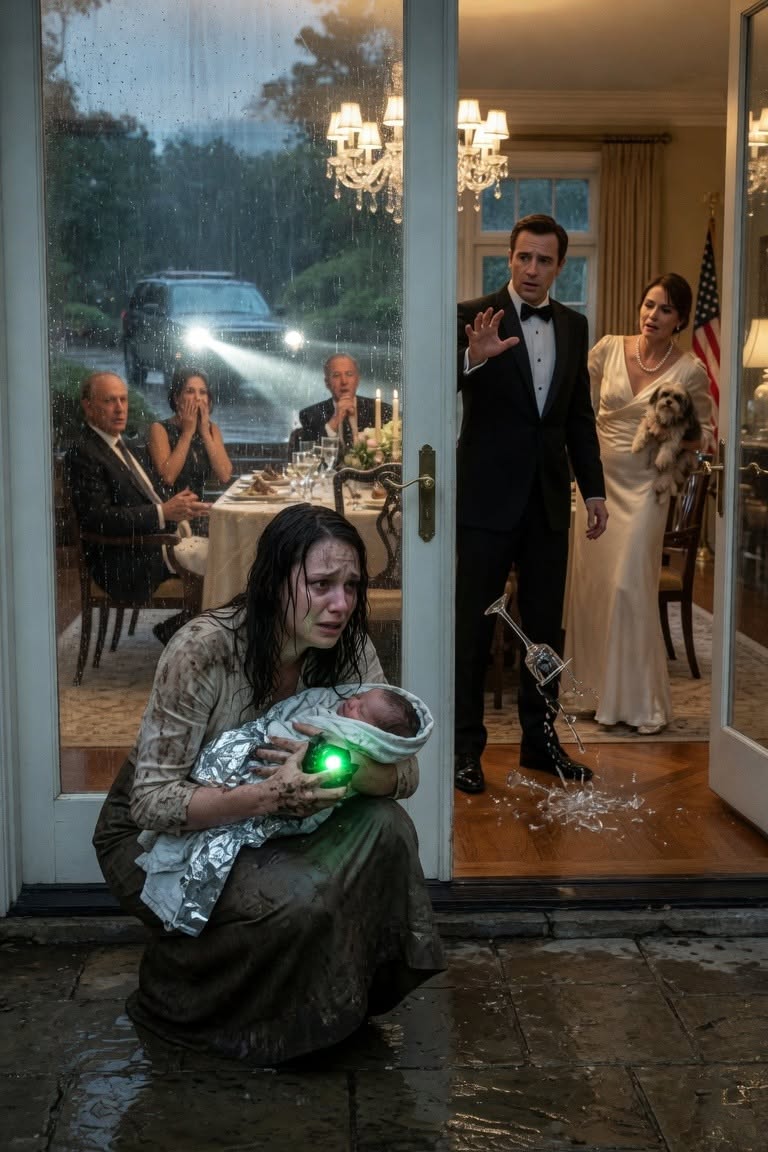
Behind us, the JSOC operator stayed positioned between the patio and the mansion doors, a human boundary line no one dared cross. The red laser had disappeared from Richard’s chest, but he hadn’t moved like a man who’d forgotten it was ever there.
Inside the house, everything had changed shape.
Not louder.
Heavier.
Guests no longer looked at each other. They looked at exits. At their phones. At the men in black moving quietly through the dining room like they were mapping the room in invisible ink.
Eleanor stood frozen in the doorway, her pearls damp now, her dog pressed tight against her arm.
“This is unnecessary,” she said, but her voice had lost its certainty. “This is a family matter.”
One of the JSOC men finally looked at her.
Not aggressively.
Just directly.
“Ma’am,” he said, “you removed a critically ill infant from medical care parameters and denied emergency transport access.”
Eleanor blinked.
Once.
Twice.
Like the sentence didn’t translate.
Richard stepped forward again, as if proximity could restore authority.
“She’s exaggerating,” he said quickly. “She does this. She panics. She—”
A soft beep interrupted him.
Not loud.
Just final.
The neonatal specialist glanced at the monitor attached to Leo’s tiny chest.
“Oxygen saturation rising,” he said.
My knees almost gave out.
I didn’t realize how tightly I’d been holding my breath until I wasn’t.
Leo’s fingers flexed again under the foil wrap.
A tiny, fragile movement—but this time, it didn’t disappear.
It stayed.
Inside the mansion, one of the hedge fund guests finally spoke.
“Richard,” he said carefully, “what the hell did you do?”
That was the moment Richard’s control cracked.
Not loudly.
Quietly.
Like glass realizing it had been under pressure long before anyone noticed.
“I didn’t do anything,” he said, but there was too much speed in it. Too much need.
The JSOC inside operator stepped closer to the dining table.
“Then you won’t mind us reviewing your security system,” he said.
No response was required.
Because two analysts were already plugging into the estate’s network at the far wall, their movements smooth, almost bored, as if breaking into a billionaire’s home was just another weather condition.
Rain hit the glass harder.
Or maybe it just sounded louder now that no one was pretending anymore.
Outside, the specialist adjusted Leo’s airway again.
“He’s stabilizing,” he said.
The words didn’t feel real.
They felt borrowed.
I looked down at my son’s face for the first time since the nightmare began to loosen.
The blue was fading.
Not gone.
But retreating.
Like something finally deciding it had lost.
And then the specialist asked quietly, “Who authorized JSOC-level escalation on a domestic pediatric case?”
All eyes shifted—subtly, instinctively—to me.
The operator didn’t answer.
He didn’t have to.
Because the beacon still sat in my hand.
Small.
Civilian-looking.
Completely unremarkable.
Except for what it was linked to.
I swallowed.
“Military medical override protocol,” I said. My voice felt steadier than it had any right to be. “Major clearance.”
A silence followed that wasn’t confusion.
It was recalibration.
Even the hedge fund billionaire had stopped moving.
Even Eleanor had stopped breathing like she owned oxygen.
Richard finally looked at me differently.
Not as a wife.
Not as an inconvenience.
But as something he had fundamentally misfiled in his mind.
“You’re lying,” he said, but it didn’t sound like belief anymore.
It sounded like hope.
The neonatal specialist gently adjusted Leo’s blanket.
“He’s improving,” he confirmed.
May you like


And for the first time since the doors of the mansion closed on me, the night didn’t feel like it was swallowing everything.
It felt like it was preparing to answer for itself.


