Chapter 5 – The Vault Beneath the Vault
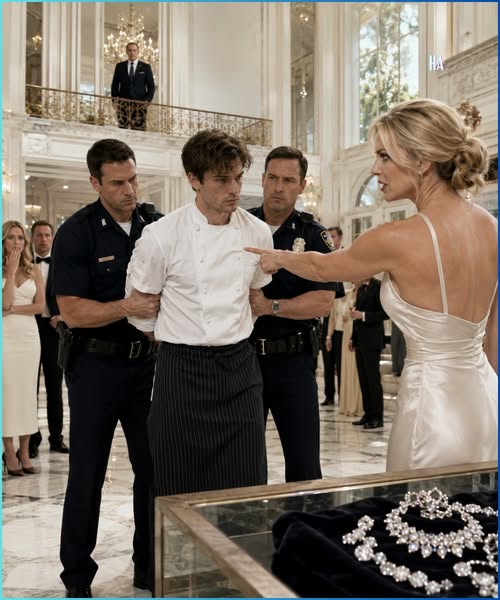
Chapter 5 – The Vault Beneath the Vault
The Anderson estate had a reputation for security.
That was what everyone believed.
What no one talked about was how security in houses like this wasn’t designed to stop theft.
It was designed to decide what kind of theft would be allowed to exist.
Franklin stood in the pantry corridor at 11:42 p.m., watching the camera mounted above the ceiling corner.
Same blind spot.
Same six seconds missing from the feed.
But this time, he wasn’t just observing it.
He was waiting for it.
He lifted the olive-branch pin from his apron and clipped it to the inner seam of his jacket instead.
Cleaner signal path.
Less interference.
Then he spoke softly into it.
“Start capture loop.”
A faint green pulse blinked once.
Franklin stepped forward.
Exactly at 11:44 p.m.—the system’s predictable refresh cycle—the corridor lights flickered for half a second.
And the blind spot opened.
Franklin moved.
Not fast.
Controlled.
Deliberate.
He passed the pantry safe.
Didn’t touch it.
Didn’t even look at it.
Because the safe was never the point.
He reached the end of the corridor where the service wall met the wine cellar entry.
A place no guest ever went.
A place even staff rarely questioned.
Franklin placed his hand against the paneling.
Then pressed once, firmly, at a seam that most people would assume was decorative woodwork.
A faint mechanical click answered him.
Behind the wall, something unlocked.
He exhaled slowly.
“So it is here,” he murmured.
The panel slid open just enough to reveal a narrow service staircase leading downward—older than the mansion itself.
Edward Anderson had never mentioned it.
Gregory Hale had never logged it.
Vivian Anderson had certainly never authorized it.
Which meant only one thing:
It didn’t belong to the current version of the house.
Franklin descended.
The air changed immediately.
Cooler.
Older.
Like the building had finally stopped pretending to be modern.
At the bottom was a second door.
No keypad.
No scanner.
Just a mechanical lock.
Franklin crouched and examined it.
Then smiled faintly.
“Old-school,” he muttered.
He pulled a thin tool from his sleeve—not a lockpick in the criminal sense, but a precision instrument from his federal days.
Sixteen seconds later, the lock clicked open.
The door opened into darkness.
And then—
light.
Soft, indirect, expensive lighting.
Franklin stepped inside.
And stopped.
Because the room he entered was not a vault.
It was a gallery.
But not of art.
Of evidence.
On one wall: framed documents.
Insurance claims.
Police reports.
Settlement agreements sealed under non-disclosure.
On another: shelves lined with jewelry boxes, watches, heirloom pieces—all labeled, cataloged, dated.
Some reported stolen.
Some reported lost.
Some never publicly acknowledged at all.
Franklin’s eyes narrowed.
“This isn’t storage,” he said quietly.
It was inventory.
A controlled system of disappearance and recovery.
A machine designed to create recoverable losses.
And then—something that made everything colder.
In the center of the room was a glass case.
Inside it:
The Marceau Archive diamond necklace.
All ninety-two carats.
Perfectly lit.
Untouched.
Not missing.
Not stolen.
Displayed.
Franklin stepped closer slowly.
His reflection appeared in the glass alongside it.
And for the first time since this began—
he understood the structure of the lie.
“This was never about theft,” he whispered.
A voice answered from behind him.
“You’re more observant than I expected.”
Franklin didn’t turn immediately.
He already knew who it was.
Vivian Anderson.
Her heels clicked softly on the stone floor as she entered the vault chamber.
No gown tonight.
No audience.
Just control.
“You found my insurance room,” she said calmly.
Franklin finally turned.
“Your secondary vault,” he corrected.
Vivian smiled.
“Everything in this house has layers,” she said. “That’s the point.”
Franklin’s gaze stayed steady.
“You staged the accusation.”
Vivian tilted her head slightly.
“I tested the system,” she replied.
Franklin’s voice dropped.
“You framed me.”
A pause.
Then she nodded once.
“Of course I did.”
No hesitation.
No shame.
Just structure.
Franklin studied her carefully.
“You wanted a scapegoat.”
“I wanted a variable removed,” Vivian corrected. “You were disrupting the rhythm.”
“The rhythm,” Franklin repeated flatly.
Vivian gestured lightly around the room.
“Do you know what this is?” she asked. “This house? This estate? It’s not a home. It’s a ledger. Everything that enters must be accounted for. Everything that leaves must be justified.”
Franklin stepped closer by one pace.
“And Maggie?” he asked quietly.
Something flickered in Vivian’s expression.
Not guilt.
Annoyance.
“She’s sentimental,” Vivian said. “That’s dangerous in systems like this.”
Franklin’s jaw tightened slightly.
“And the missing earring?”
Vivian smiled again.
“Oh, that?” she said. “A trigger. Small enough to ignite suspicion. Just enough to redirect attention where I needed it.”
Franklin nodded slowly.
“So the system blind spot…”
“Pre-planned,” she said.
“The contractor?”
“Selected.”
“The timing?”
Vivian shrugged lightly.
“Predictable people follow predictable routines.”
Silence stretched between them.
Not emotional.
Not dramatic.
Just two opposing systems finally exposed to each other.
Franklin looked at the necklace again.
Then back at her.
“You didn’t just want me blamed,” he said. “You wanted me neutralized.”
Vivian stepped closer.
“You were never supposed to look past the kitchen,” she said softly.
Franklin’s voice was almost quiet now.
“You made one mistake.”
Vivian raised an eyebrow.
“Oh?”
Franklin met her gaze directly.
“You assumed I was only a chef.”
For the first time—
her expression tightened slightly.
Not fear.
Recognition.
Because in that moment, somewhere above them in the mansion—
a second security system that Vivian didn’t know existed quietly switched from passive monitoring to active recording.
And Franklin Davis reached for the vault light switch.
May you like


Not to see the room.
But to make sure everything inside it could be seen.


