CHAPTER 7 — Some Gifts Take Years to Open
CHAPTER 7 — Some Gifts Take Years to Open
The singing had barely ended when there was another knock at the door.
This time, no one rushed to answer.
After everything that had happened, another surprise felt almost expected.
My father opened the door.
Standing on the porch was the woman from the black sedan.
She wore a navy blazer, carried a leather portfolio, and offered a polite smile.
"Good afternoon. My name is Karen Ellis."
She held up an identification badge.
"I'm with the Department of Child and Family Services."
Every conversation stopped.
Michael instinctively stepped closer to Noah.
Karen noticed.
"Please don't worry," she said gently. "I'm not here because of you."
She glanced toward the street.
"I'm here because someone submitted a report several days ago concerning repeated emotional abuse involving a minor."
My stomach tightened.
"Several days ago?"
Karen nodded.
"Yes."
She opened the folder.
"The report was filed before today's birthday party."
Brenda.
Someone had already been worried enough to call.
Karen looked around the room.
"I understand Mrs. Brenda Miller has already left?"
"She has," Patricia answered.
Karen sighed.
"I was hoping to speak with her."
She paused before adding,
"However..."
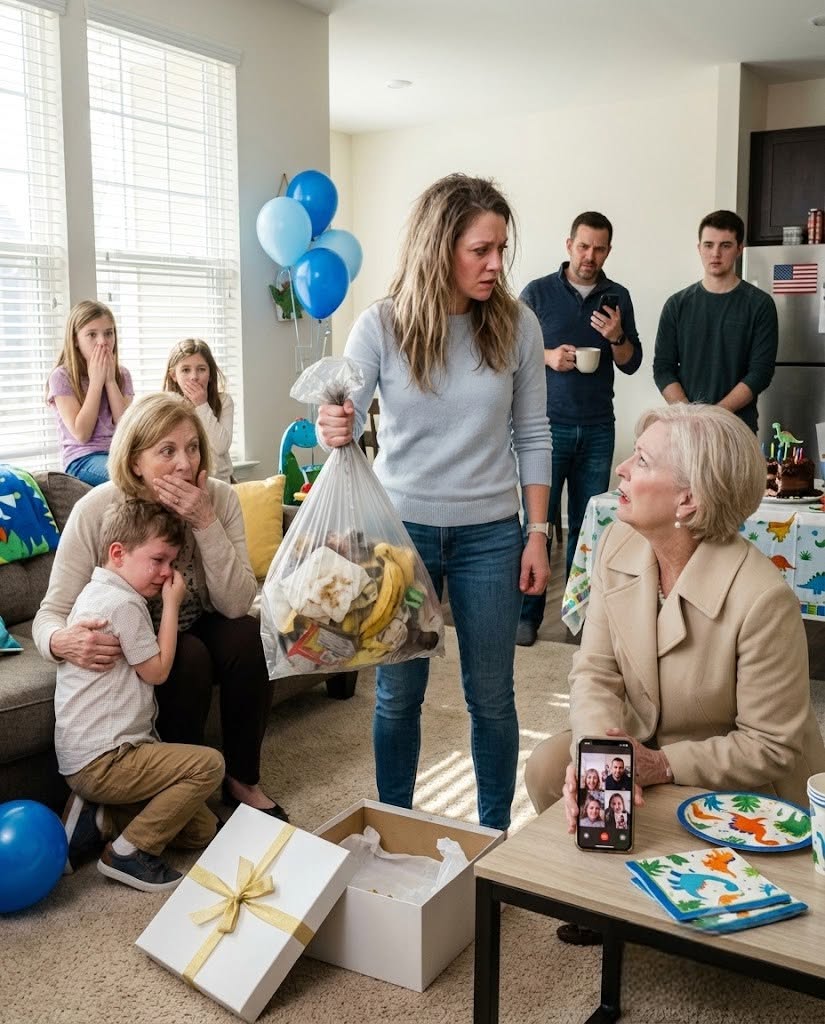
She looked at the garbage still sitting in the kitchen trash can.
"...it appears I may have arrived after witnessing the reason for the report."
Michael spoke quietly.
"Someone reported my mother?"
Karen nodded.
"More than one person, actually."
Everyone looked surprised.
Karen continued.
"We received concerns from a preschool teacher, a former neighbor, and a member of your extended family."
Rachel's eyebrows rose.
"So people have been noticing this?"
"For quite some time."
Karen's expression remained professional.
"Emotional abuse is often difficult to prove."
"But repeated patterns matter."
She looked at Noah.
"Today's incident, especially since it was witnessed and recorded, provides important context."
Michael lowered his head.
"I should have seen it."
Karen answered kindly.
"Children raised in controlling homes often normalize behavior that outsiders immediately recognize as harmful."
Michael looked up.
"So I'm not the only one?"
"No."
"You are far from the only one."
Those words seemed to lift a weight he had carried since childhood.
Karen spoke with us for nearly an hour.
She didn't interrogate Noah.
Instead, she sat on the floor beside him while he proudly showed her the dinosaur drawings covering the once-empty white box.
"What happened to your present?" she asked gently.
Noah smiled.
"It got turned into a better one."
"How?"
"My family fixed it."
Karen looked at me.
Then at Michael.
She smiled.
"I think that's exactly what happened."
Before leaving, she handed us a business card.
"If Mrs. Miller attempts to contact Noah in ways that ignore your boundaries, please call."
Michael nodded.
"We will."
The weeks that followed weren't easy.
Healing rarely is.
Michael started therapy within two weeks.
Not because anyone forced him.
Because he finally understood that surviving childhood isn't the same as recovering from it.
Sometimes I'd find him sitting quietly after Noah had gone to bed.
Thinking.
Remembering.
Once he admitted something that broke my heart.
"I don't have many happy memories before I was ten."
I squeezed his hand.
"Then let's make new ones."
And we did.
Saturday pancakes.
Camping in the backyard.
Movie nights where Noah always insisted on watching the same dinosaur film.
Small things.
The kind of ordinary moments that frightened children often grow into healthy adults remembering.
Brenda tried calling.
At first every day.
Then every week.
Letters arrived.
Some blamed me.
Some blamed Patricia.
Some blamed "modern parenting."
None accepted responsibility.
Michael read only the first one.
Then he quietly placed the rest unopened into a box in the hall closet.
"I'll read them," he said, "when they're written by someone willing to tell the truth."
None ever were.
Three months later, the family gathered again.
Not for a holiday.
Not for an argument.
For Noah.
His kindergarten held a "Family Heroes Day."
Parents and grandparents could come talk about courage.
When Noah's teacher asked who he wanted to invite, he answered without hesitation.
"My Mommy."
"My Daddy."
"And my Great-Grandma Patricia."
The teacher smiled.
"What makes them heroes?"
Noah thought carefully.
Then he said,
"They protect people even when it's hard."
I don't think any award I've ever received could have meant more than those words.
Patricia passed away peacefully the following spring.
She was ninety-two.
At her memorial service, dozens of relatives came who hadn't attended the same family event in years.
Not because they had suddenly become close.
Because Patricia had spent her final months bringing them back together.
In the letter she left for the family, there was one paragraph everyone remembered.
"Families are not measured by how well they hide cruelty. They are measured by how bravely they end it."
Michael framed those words.
They still hang in our hallway.
Right beside a photograph of Noah's sixth birthday.
Epilogue — The Real Gift
One year later.
The house was louder.
Fuller.
Healthier.
Blue balloons floated across the ceiling again.
There was another dinosaur cake.
This time, Noah insisted on helping frost it himself.
The kitchen was a mess.
The counters were covered in sprinkles.
No one cared.
As guests arrived, Noah ran to the front door wearing a paper dinosaur crown.
He hugged every person before asking only one question.
"Are you here to celebrate?"
Every answer was yes.
Halfway through the party, he disappeared into his room and returned carrying an old white box.
The same one.
Still covered in faded stickers, crooked hearts, glitter stars, and childish dinosaur drawings.
He handed it to me.
"I want to show everyone."
Inside wasn't garbage.
It was treasure.
Birthday cards.
School drawings.
Tiny plastic dinosaurs.
A ribbon from his first soccer medal.
A family photo from our camping trip.
The business card Karen had given us.
And on top of everything else...
A folded piece of paper written in Michael's careful handwriting.
Noah asked me to read it aloud.
I unfolded it.
It said:
To my son,
If you ever wonder what kind of man I hope you become, it isn't the strongest man in the room.
It isn't the richest.
It isn't the loudest.
I hope you become the man who protects people when protecting them costs something.
I hope you never confuse fear with respect.
I hope you never mistake control for love.
And if I ever fail you, I hope you are brave enough to tell me, because real families tell the truth.
Love,
Dad
When I finished reading, Noah wrapped his arms around Michael.
"You kept your promise."
Michael smiled through tears.
"I'm going to keep making it."
As the candles flickered, Noah closed his eyes.
"What did you wish for?" I asked after everyone applauded.
He grinned.
"I can't tell you."
"Why not?"
"Because then it won't come true."
He leaned closer and whispered anyway.
"But I think it already did."
I looked around the room.
My parents laughing with Richard.
Rachel helping the younger cousins fill piñatas.
Patricia's framed photograph smiling from the bookshelf.
Michael kneeling beside our son instead of standing behind someone else's shadow.
The room wasn't perfect.
Neither were we.
But there was no fear hiding behind the laughter anymore.
The little white box that had once carried garbage had become our family's keepsake box—a reminder that the cruelest gifts can be transformed when people choose honesty over silence, courage over comfort, and love over control.
And every year after that, on Noah's birthday, we added one more memory to the box.
May you like


Not because we wanted to remember the day cruelty arrived.
But because we wanted to remember the day it finally lost.


