Chapter 3 - The Library of Silent Things
The east guest suite was larger than the entire apartment Darius had shared with his grandmother on 79th Street. The bed was a massive island of white goose down, surrounded by heavy blue velvet curtains that blocked out the sight of the dark Chicago skyline.
After a hot bath that left his skin pink and smelling of sandalwood, Darius sat on the floor by the radiator, wearing a pair of silk pajamas that were far too large for him, the sleeves rolled up three times to clear his hands. His old green backpack sat on the vanity chair, looking dirty and out of place against the polished gold leaf of the mirror.
There was a soft tap at the door.
Darius didn't say "come in," because he rarely said anything at all now. He simply watched the brass knob turn. The door opened to reveal Eleanor Callaway.
She had changed into a gray wool shawl over a simple lavender dress. She didn't have her cane. She stood in the doorway for a long moment, her old eyes scanning the room until they found the boy sitting by the heat vent. She didn't look like a resident of a gold-coast mansion; she looked like a woman who had spent her life carrying water from a well in the hills, her spine curved by the weight of things that couldn't be said aloud.
She walked in, her footsteps completely silent on the thick Persian rug. She didn't sit on the bed or the armchair. She came right over to the floor and sat down on the rug across from Darius, her long skirt rustling like dry grass.
Darius didn't move. He smelled the scent of old paper and lavender water that followed her.
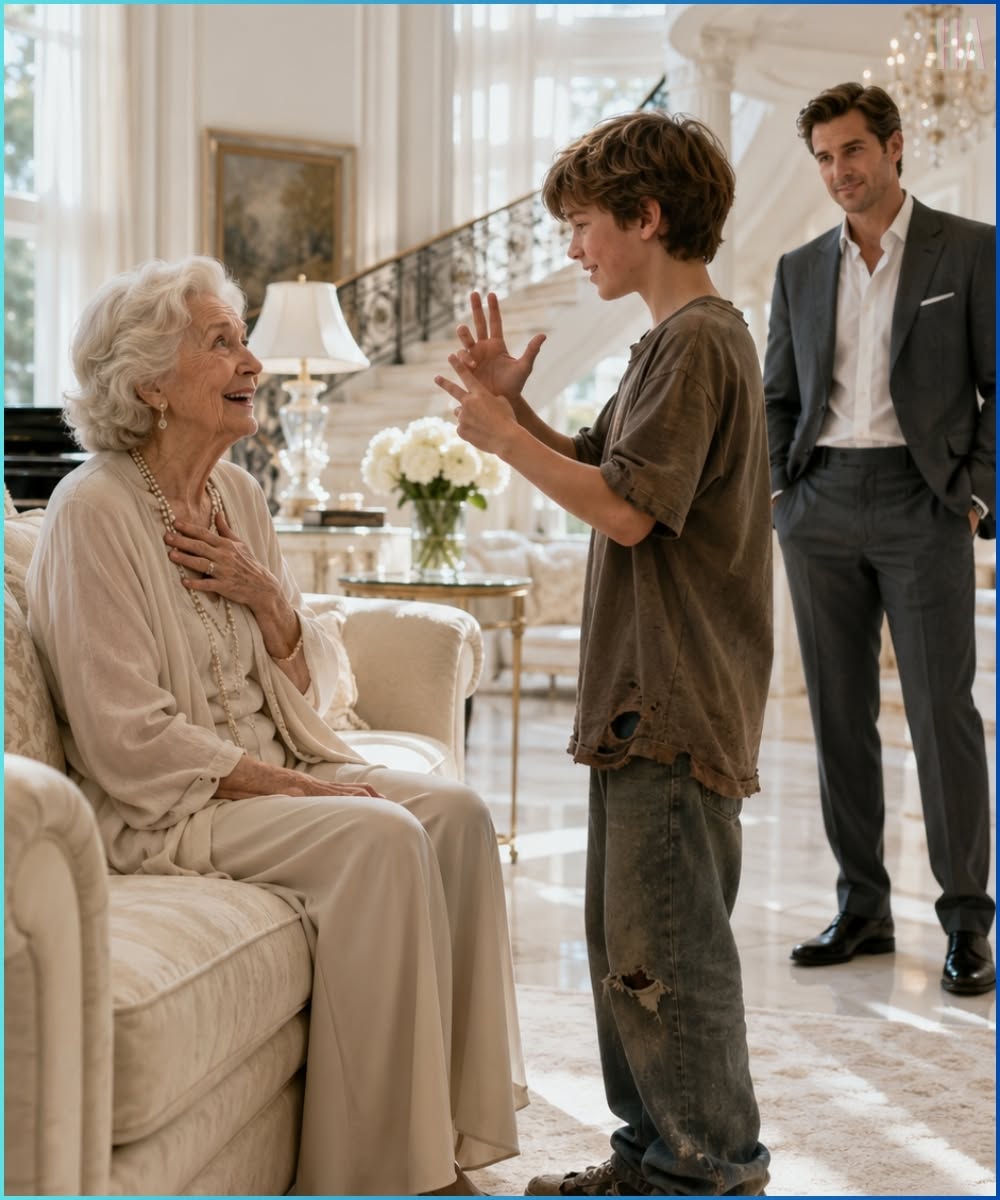
Eleanor lifted her hands. Her fingers were long, crooked with arthritis, the nails short and clean. She didn't start with a question. She held her right hand out, palm up, then took her left index finger and drew a small, slow circle in the center of her palm.
Darius’s breath hitched. He knew that sign. It wasn't the exact one his grandmother used for tell me a story, but it was the cousin to it. It was the universal movement of a human being asking for an account of the dark.
Darius lifted his hands. He pointed to his own chest, then made the sign for small. Then he held up three fingers and shook them slightly side to side—the third house, the temporary place, the room with twelve beds.
Eleanor watched his fingers with an intensity that seemed almost physical. She didn't look at his face; she looked at the space between his hands, tracking the rhythm of his gestures. When he finished, she lifted her own hands and made a sharp, downward chopping motion with both palms—cut, broken, ended. Then she pointed to her own ears, shook her head, and held her hands out like an empty basket.
The world is empty of sound, and the baskets are all broken.
Darius felt a strange, warm sensation in his chest. For fourteen months, adults had been shouting at him, speaking slowly to him, using big words through interpreters who moved their hands like machines—correct, stiff, and dead. But Eleanor’s signs weren't correct. They were rough. They were shaped by the wind of a mountain town that had vanished fifty years ago. They were survival signs.
Darius leaned forward, his rolled-up sleeves slipping down his arms. He took his thumb and forefinger and pinched the fabric of his pajama top, then pointed toward the window where the sleet was still turning into ice. He made the sign for the coat that was left behind.
Eleanor’s face softened. A line between her brows that looked like it had been carved with a knife over three years of solitary grief began to relax. She reached out, her old, cool fingers gently brushing against the edge of Darius’s hand. She didn't hold it; she just rested her skin against his for three seconds, letting the heat travel between them.
Then, she signed: The boy has a coat now. The house is warm. Stay.
Darius didn't answer with a sign. Instead, he did something he hadn't done since the funeral on 79'th Street. He let his head drop forward until his forehead rested against Eleanor’s knee, his tiny shoulders rising and falling against the wool of her dress. Eleanor’s hand came down onto his back, her palm moving in a slow, circular motion that didn't need a dictionary to translate. It was the rhythm of a mother who had spent forty years comforting a son, and who had finally found someone who knew how to ask for it.
From the hallway, through the half-open door, Richard Callaway watched them. He was holding a stack of legal documents his attorneys had couriered over from the office—emergency foster custody waivers, temporary guardianship petitions, financial guarantees. He had been ready to storm the court system in the morning with a army of high-priced lawyers.
May you like


But as he saw his mother’s hand moving on the boy's back, he slowly lowered the papers to his side. He realized that his money could buy the court, but it couldn't buy the silence that was currently saving his mother’s life. He looked down at the documents, then at the shadow of Vivien Cross standing at the far end of the corridor, watching him with an unreadable expression.
Richard’s eyes narrowed. He didn't know why, but his corporate instincts—the ones that told him when a partner was about to pull out of a deal or when a competitor was planting a spy in his boardroom—were screaming at him. The danger wasn't in the state capital or the foster care agency. The danger was already inside the gates.


