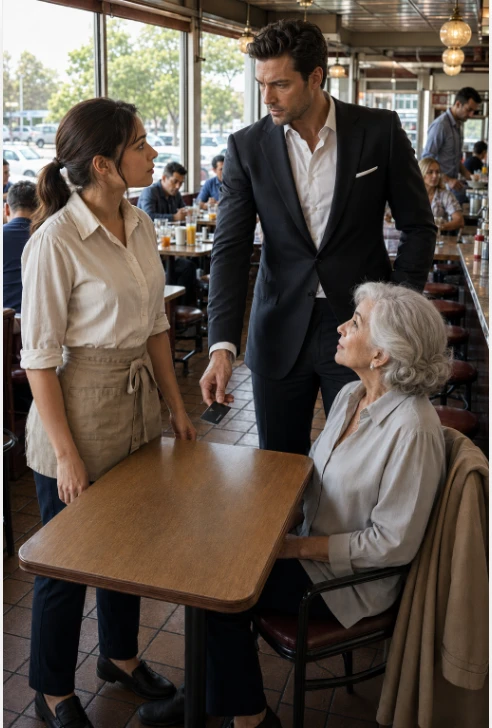
chapter 2 : No one helped.
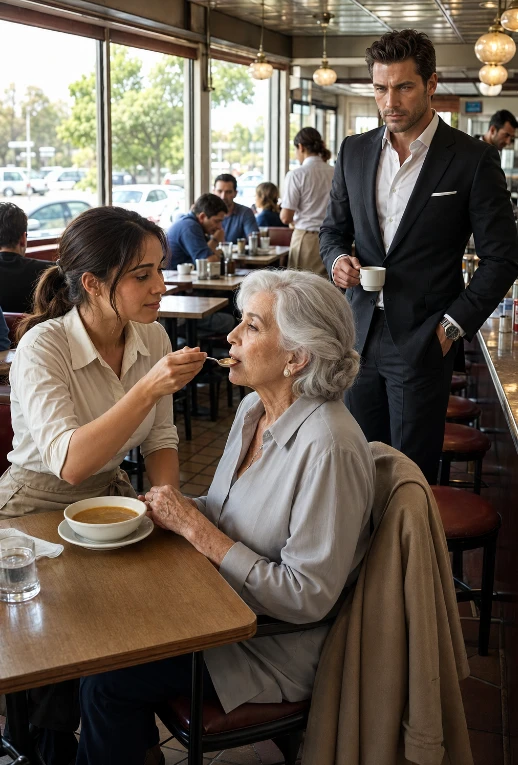
By the time Elena Moreno noticed the old woman’s trembling hands, three customers were already angry, two plates were getting cold, and her manager was staring at her like one more mistake would cost her the job.
The lunch rush had turned Rosewood Diner into a battlefield of clattering plates, ringing phones, impatient voices, and steaming coffee. Elena moved through it all like someone running from invisible fire, balancing trays against her hip while forcing a smile she no longer felt.
She had been awake since four that morning.
Her rent was overdue.
Her little brother’s school fees were due Friday.
And the hospital had called twice about an old bill she still could not pay.
But none of that mattered to the people waving empty cups in the air.
“Miss! Refill!”
“Where’s my sandwich?”
“I asked for no onions!”
Elena swallowed her exhaustion and kept moving.
Then she saw the woman in the corner booth by the window.
At first, the elderly woman looked too elegant to belong there. Her silver hair was carefully styled, her pearl earrings caught the afternoon light, and her pale gray blouse looked expensive in a quiet, old-money kind of way. She sat with straight posture, chin lifted, hands near her plate.
But something was wrong.
Her fingers shook.
Not slightly.
Violently.
She tried to lift her fork, but it trembled halfway to her mouth before slipping sideways. A piece of food fell back onto the plate. She closed her eyes for one second, breathing through what looked like shame.
Elena froze.
The diner did not.
People kept talking. Cups kept hitting tables. The kitchen bell rang sharply.
“Elena!” her manager barked from behind the counter. “Table six is waiting!”
But Elena’s eyes stayed on the old woman.
The woman tried again. This time her whole hand stiffened midair. The fork rattled against the plate, loud enough for the young couple at the next table to glance over. They looked away immediately, embarrassed by her embarrassment.
No one helped.
Elena felt something twist in her chest.
She had seen that struggle before.
Her grandmother, years ago, sitting at their tiny kitchen table, whispering, “Don’t look at me like that, niña,” while her hands betrayed her over a bowl of soup.
Elena walked to the corner booth.
“Ma’am,” she said gently, lowering her voice so no one else would hear, “are you okay?”
The elderly woman looked up. Her eyes were blue, pale, and tired, but still beautiful.
For a moment, pride flickered there.
Then it faded.
“Parkinson’s,” she whispered. “Some days, even eating becomes a battle.”
Elena nodded as if the confession did not make the woman smaller.
As if it was not shameful.
As if the whole world should already know how to be kind.
“I’ll be right back,” Elena said.
The old woman’s eyes widened. “No, dear, please. You’re busy.”
“I know.”
Elena smiled softly.
“Still coming back.”
She hurried to the kitchen, ignored the cook shouting about backed-up orders, and returned with a fresh bowl of warm chicken soup. Then, without waiting for approval, she pulled a chair beside the elderly woman and sat.
Across the diner, her manager’s mouth fell open.
“Elena,” he hissed, “what do you think you’re doing?”
A man at table six snapped, “Excuse me! Are we invisible?”
Elena heard every word.
But she picked up the spoon anyway.
The elderly woman stared at her, startled. “You don’t have to do this.”
“No need to rush,” Elena said, dipping the spoon carefully. “We’ll take our time.”
The old woman’s lips trembled.
Not from the illness this time.
From emotion.
Elena lifted the spoon slowly, waiting until the woman was ready. The first sip was awkward. The second was easier. By the third, the elderly woman’s shoulders loosened, and her eyes shone.
For the first time since she entered the diner, she smiled.
It was not a big smile. It was fragile, almost afraid to exist. But it changed the whole room for one person watching.
Near the counter stood a tall man in a charcoal suit.
He had entered ten minutes earlier, ordered an espresso, and said almost nothing. His dark hair was perfectly styled, his jaw sharp, his watch worth more than Elena’s car. He looked like a man who did not wait for anything or anyone.
But now he was still.
Completely still.
His espresso sat untouched beside his hand.
His name was Adrian Vale.
People in the city knew that name. They knew the towers bearing his company logo, the hospitals his foundation funded, the hotels he owned, the technology firm he had turned into a billion-dollar empire before forty.
They also knew another thing.
Adrian Vale was not sentimental.
He believed in numbers, efficiency, contracts, performance. If something broke, he replaced it. If someone failed, he dismissed them. If a problem could not be solved with money, he rarely had patience for it.
But the woman Elena was feeding was his mother.
Vivian Vale.
Once the most respected philanthropist in the city.
Once untouchable.
Now trapped inside a body that shook without permission.
For years, Adrian had paid for the best doctors, private nurses, specialists from Europe, treatment plans, experimental therapies, luxury care, every possible comfort.
He had spent millions.
But he had not given her afternoons.
He had not sat beside her and said, “We’ll take our time.”
He watched his mother look at Elena with more trust than she had shown any professional caregiver in years, and something in him cracked silently.
When the soup was nearly gone, Vivian reached for Elena’s wrist with trembling fingers.
“What’s your name, dear?”
“Elena.”
Vivian smiled. “That suits you.”
Elena laughed softly. “My grandmother used to say it meant light.”
“She was right.”
Elena lowered her gaze quickly, but Vivian noticed.
“Is she gone?”
Elena nodded. “Three years.”
“I’m sorry.”
“So am I.”
A silence passed between them, warm and aching.
Then Adrian stepped forward.
The diner seemed to shrink around him.
Elena felt his presence before she looked up. He stood beside the table, tall and controlled, his expression unreadable.
His voice was low.
“You don’t know who my mother is?”
Elena blinked. “No, sir.”
“You had no idea who I am?”
“No.”
“Then why did you help her?”
The question was simple.
But the way he asked it made Elena feel as if the whole diner had stopped breathing.
She stood slowly, wiping her hands on her apron.
“Because she needed help.”
No performance.
No fear.
No calculation.
Just truth.
May you like


For the first time in many years, Adrian Vale had no answer.
He reached into his suit jacket, withdrew a black business card, and placed it on the table.